♡ it’s NOT a selfish practice
Mindfulness has sometimes been misunderstood as a selfish practice that’s all about bringing your attention to what YOU’RE doing in the present moment so that YOU can simply think about YOU all the time! By contrast, the ethos and basis of practicing right mindfulness is about caring for yourself, reducing and overcoming harmful influences, and being compassionate to yourself first as well as to others. Yes, that’s right, to yourself first but THEN you will be more present for others and those you care about. There is a lot of suffering in the world and you may not be able to do much to alleviate the suffering of many of the people you see or meet, but sometimes a simple kindness towards the individual, whether in word or an intentional kind thought or prayer hoping for the alleviation of their suffering, is often all we can do. Sending a silent prayer, a kind thought, a smile or practical help if we’re able is right mindfulness. As we develop our practice, we’ll understand our need for setting our intention and will see the difference between becoming more present and self-aware and not just self-absorbed.
♡ it’s NOT just a buddhist practice
Although mindfulness may have been taught by Buddhists it is not exclusive to any belief system. It is a natural skill /technique that when practiced can enrich your life. There are many very natural processes like deep breathing, prayer and nourishing stretching exercises (such as Yoga) that have been brought into many belief systems as ‘good practices’ as the benefits are clear. It doesn’t make them exclusive though … it just makes them good practices. Whatever your faith or belief, only YOU carry within your heart the focus of your faith/belief. My hearts focus on a daily basis, in whatever I do, is on God through Jesus. He’s at my centre and the strong foundation that keeps me grounded when the storms of life come. So, mindfulness can be practiced by anyone with any faith, belief or philosophy. To believe otherwise is to limit a very natural avenue of the full expression of human experience.
♡ it’s NOT just meditation
Anyone who has attended one of my classes or events will have heard me say “mindfulness is like meditation on the go”. In my experience, many of the benefits of mindfulness are very similar to those achieved from meditation, and certainly meditation is part of the practice of mindfulness. Unless you’re meditating on unwholesome thoughts of course, and then you’re back to no.1 with the question of intention and the ethos around caring. Mindfulness is always ethically correct and seeks to do no harm to you or others. I would say that if I’m stuck in a traffic queue or stood in line in a grocery store then I do start to practice mindfulness and it’s a very similar practice to open awareness meditation. Whereby you are being consciously aware of your thoughts and what you are sensing, but without judgment. It’s about being focused on the task at hand yet being aware of everything else that you’re thinking and sensing, and allowing those thoughts and experiences to drift by calmly.
♡ it’s NOT just a relaxation practice
Yes, mindfulness practice can result in feeling more relaxed and less stressed and anxious but sometimes it can be quite challenging to stop and bring yourself to the present moment, especially if the present moment is stressful. Sometimes as we allow ourselves to be open to how we’re feeling and thinking at any given time, without judgement, we can face memories or thoughts that initially cause us to feel quite anxious. But one of the aims of mindfulness is to face, process and clear emotional and mental issues that may be robbing us of a more enriched life. It can be uncomfortable, but ultimately worth it as we learn how to self soothe when needed and again approach ourselves with kindness and non-judgement. So, whether it’s a happy or a sad moment, learning how to sit with the experience with compassion and openness, and accept the ‘as is’ will help you to make peace with your life. It does not mean that you have to accept a bad thing that’s happened to you as though it’s ok, it means that you accept where you are in life at that moment. Maybe the process will highlight that you need further support and healing … and that’s ok!
♡ it’s NOT just achieving a quiet mind
If mindfulness was just achieving a quiet mind, I’d have to say that I haven’t achieved it yet! Although that’s not entirely true as I do experience a quieter mind and peaceful states of bliss at times. But not all the time. I think many people give up on attempting to practice mindfulness or meditation as they are under the misconception that they are needing to ‘empty their minds,’ which is of course not possible. It’s about noticing your thoughts and seeking to not judge them or have an emotional attachment to them. If however, you’re doing an intentional guided relaxation and you are imagining beautiful thoughts or a beautiful place then absolutely YES you should think it, feel it, taste it and focus fully on the nourishing thoughts at their deepest level. They will send a surge of well-being through your body, physically, mentally and emotionally.
When referring to negative and unpleasant thoughts that we have, however, if we ruminate on and allow ourselves to attach a strong negative emotion to these, this will rob us of our peace. So, a useful picture is to see your consciousness as a vast ocean and your thoughts are the waves. Sometimes the conscious ocean is very choppy and stormy. The waves (thoughts) are thrashing and turbulent. If you were attempting to swim with those waves you’d probably drown as you would simply not be able to keep your head above the water. That’s a really helpful picture of when our thoughts are busy and tumultuous …. we sometimes feel like we’re drowning in them.
However, the aim when practicing mindfulness and meditation is to calm that sea of thoughts. If you tried to catch a wave in your hand you would never be able to, would you? Attempting to catch our thoughts can be similar. It takes practice. So, simply notice the thoughts with kindness and non-judgement (even if the thoughts are not very pleasant). Allow yourself to be in the moment, accepting where you are at, and with practice your inner sea will become calmer. If it doesn’t initially because the stress of the situation is just too intense, then simply notice that and be ok with it. Maybe consider doing some EFT Tapping on any issues that have risen up for you (another book in my SAMIJOS series), and then notice the difference as you return to your mindfulness practice.
♡ it’s NOT necessary to always be in a quiet place
Some feel that when practicing mindfulness, to be fully aware and to feel the sensory sensations of the body, then a place of complete quietness is needed. I would agree that taking ourselves to a peaceful place from time to time for quiet reflection and a break from the busyness of everyday life, is beneficial and in fact essential. If you’re just starting your mindful practice, then I’d say it’s a particularly good idea. If your practice was purely within this kind of setting though then I’d say it was more a meditation practice, which of course is an aspect of mindfulness and an excellent addition to your life. For maximum benefit though, a full mindfulness experience should be practiced any time, any place and whether it’s quiet or not. That is, after all, real life!
♡ it’s NOT about escaping reality
When life is complex and challenging then a way to escape from the stress and often unsettling aspects of life is important. Hence why scheduling holidays or weekend breaks are helpful to stop, relax and be refreshed. Not everyone can afford holidays or weekend breaks though so the need to escape becomes more intense. Drugs and alcohol can become an avenue for this need to escape, but this can become very destructive in more ways than one. I myself used both routes at different times in my life, and at first they seemed enjoyable and appeared to bring about the desired outcome. I still had to face the trials of my daily life when their effects had worn off and the coming back to reality was even more intense as I hadn’t processed well why I was feeling the way I felt about my life. You then also have to deal with the hangovers and withdrawals which undermine your well-being further, and the very real and more dangerous aspects of addiction that can destroy your life (and potentially damage the lives of those you love).
Mindfulness can sometimes be seen as a route to escape life’s struggles and concerns. It’s certainly a healthier route than alcohol and drugs. A similar view is given to practicing meditation, and I can see why. As you practice mindfulness there is an aspect of taking your mind off your problems to be in the present moment, such as leaving a busy office and walking through the park at lunch time. You walk, and you feel how your feet feel connecting with the ground. How does your body feel? Do you have any tension that you can breathe through and release? What can you see? The flowers and the trees, the different colours, shapes, sizes and smells. The sky, the sun, the grass … breathing in and out and fully connecting with the moment, does serve to give us an escape from a busy office. It helps us to go back with a clearer mind, somewhat refreshed and feeling ready to re-enter the day. Mindfulness has aspects of escapism, but it is more concerned with becoming better connected with who you are and how you feel about your life. Facing, even if it’s uncomfortable, the issues that you may have buried within you and processing them in a way that brings you greater personal freedom and connection with the world. Sometimes this experience can signpost you to the realisation that you need further help through therapy/life coaching etc. Mindfulness is not a cure, it’s a tool!
I do hope you found that helpful ☺. Join me next week and we’ll look at more ways to benefit from mindfulness,
Love & blessings, Sam xx
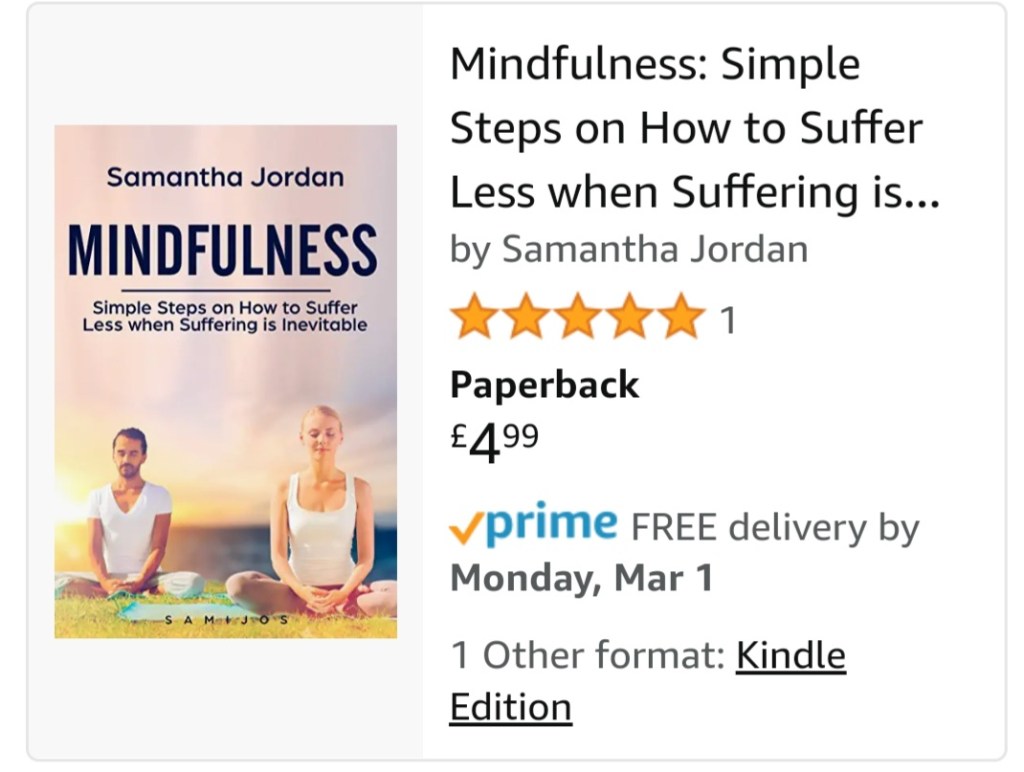
(I’ve adapted today’s blog from a chapter in my book on Mindfulness. If you want to find out more then see image below and find me on Amazon 📚☺)
 Samantha Jordan TLC